

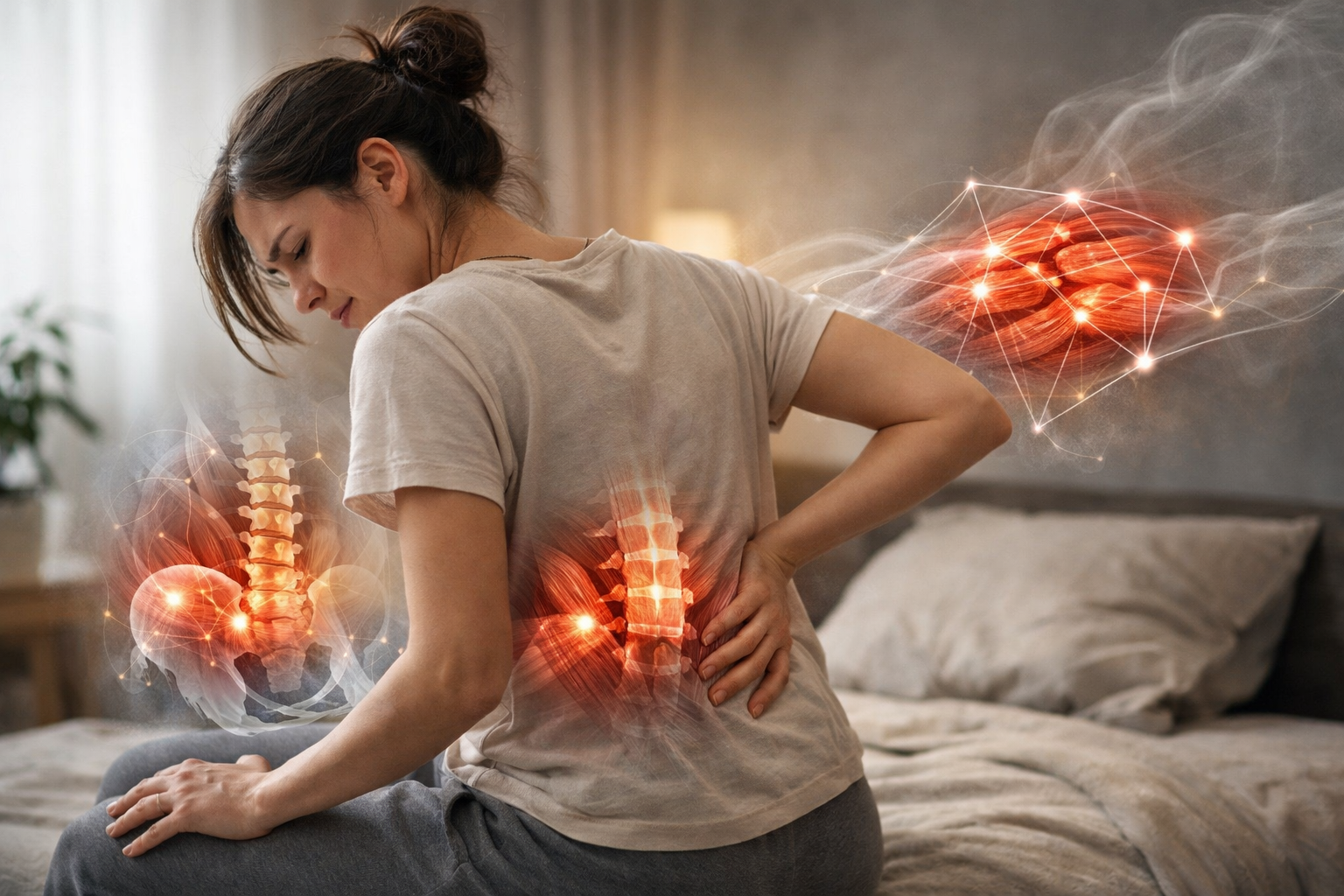
Many people wake up with back pain, hip tightness, stiff shoulders, or a deep sense of fatigue — even though they haven’t lifted anything heavy, exercised intensely, or injured themselves.
Over time, this discomfort becomes something we quietly accept.
We blame age.
We blame work.
We tell ourselves it’s normal.
But what if it isn’t?
What if your body pain isn’t caused by overuse — but by how your body has been holding itself every day?
The Modern Body Is Rarely at Rest — Even When You Are
One of the most overlooked causes of chronic pain is prolonged low-level muscle tension.
Modern life encourages it.
We sit for long hours.
We breathe shallowly.
We carry mental stress without realizing it.
We stay alert long after the workday ends.
Even when the body looks still, the nervous system may remain in a constant state of readiness.
Over time, muscles adapt to this state by staying partially contracted — especially in areas responsible for stability and protection:
-
The lower back
-
The hips and glutes
-
The neck and shoulders
This ongoing tension reduces blood flow, limits oxygen delivery, and allows metabolic waste to accumulate inside muscle tissue — creating pain without a single “heavy” movement.
When the Core Stops Supporting, Other Muscles Compensate
Another common pattern seen in modern pain is muscle compensation.
Deep core muscles are designed to provide subtle, continuous stability to the spine and pelvis.
But when these muscles become inactive — often due to prolonged sitting and poor breathing patterns — other muscles step in to compensate.
Most often, the gluteal muscles and lower back muscles take on more load than they were designed for.
Instead of alternating between contraction and relaxation, they remain tense for long periods.
Over time, this leads to:
-
Muscle hardening
-
Trigger point formation
-
Pain that feels deep, structural, and stubborn
The pain feels like it comes from joints or bones — but the source is muscular overload.
Stress Lives in the Body, Not Just the Mind
Pain is not purely mechanical.
Research shows that psychological stress increases muscle tension and pain sensitivity. When the nervous system stays in a sympathetic (fight-or-flight) state, muscles naturally contract as a protective response.
This is why pain often worsens:
-
During emotionally demanding periods
-
When sleep quality drops
-
When the mind never truly slows down
The body remembers what the mind carries.
Muscle tension becomes a physical record of unprocessed stress.
Why Massage or Rest Alone Often Isn’t Enough
Many people seek temporary relief through massage, stretching, or rest — and while these can help, the relief often fades.
Why?
Because pain rooted in chronic tension is not just about the muscle — it’s about the relationship between the nervous system, breathing, movement, and awareness.
If the body returns to the same patterns of holding, bracing, and rushing, pain will return — regardless of how often it is treated.
Recovery Is Not About Doing Less — It’s About Listening More
True recovery is not passive.
It is not simply stopping activity.
Recovery begins when we:
-
Notice where the body is holding tension
-
Allow muscles to release rather than force them to stretch
-
Restore calm to the nervous system
-
Rebuild stability gradually and consciously
Recovery, as a Practice
Pain that appears without heavy effort is not a sign of weakness.
It is often a sign that the body has been carrying too much — for too long — without being heard.
Recovery is not a single action.
It is a daily relationship with your body.
And it begins with one simple shift:
Not pushing harder — but listening more deeply.
Recovery, as a practice.
This is where mindfulness becomes essential.
When attention returns to the body — to breath, sensation, and posture — muscles are given permission to let go.
Tools like gentle heat, supportive massage, and slow, intentional movement can support this process — not as fixes, but as companions to awareness.


Share:
Why Stress Is the No.1 Cause of Neck and Shoulder Pain
The Pain You’ve Grown Used to May Not Be Coming from Your Joints